
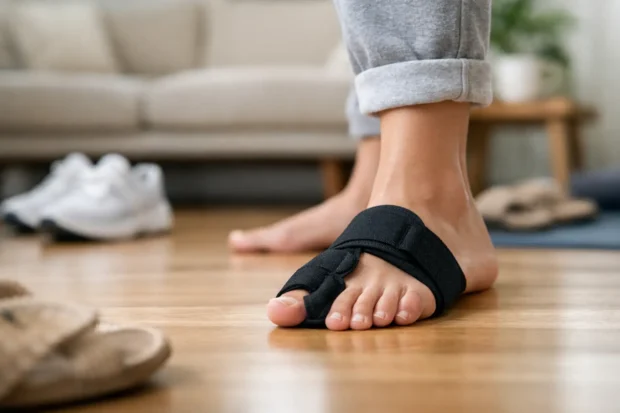
If your big toe keeps drifting inward, your shoes start reminding you fast. You feel rubbing at the joint, pressure along the side of the foot, and that familiar frustration of trying one more pad or splint that looks promising until you actually put your shoes on. Big toe alignment support matters most in real life, not just while sitting on the couch or sleeping.
For many people, the goal is not to force the foot into a perfect position overnight. It is to reduce irritation, support a more natural toe position, and make walking, standing, and getting through the day feel more manageable. That is where the right kind of support can help – especially when it is designed to move with you instead of fighting your footwear.
What big toe alignment support actually does
The phrase can sound more dramatic than it needs to be. In practical terms, big toe alignment support usually means a soft or structured aid that encourages the big toe into a gentler, more neutral position while also reducing friction around the bunion area.
That distinction matters. Many people assume alignment support should aggressively pull the toe straight. In reality, too much force can feel uncomfortable, create pressure in the wrong spots, or make a product impossible to wear consistently. Support works best when it helps guide the toe, cushions the joint, and stays comfortable enough to use often.
Consistency is the trade-off most people discover the hard way. A rigid splint may look more corrective, but if it only comes out of the drawer once a week, it is not doing much for day-to-day comfort. A thinner, flexible option may feel less intense, yet it is often more useful because you can actually wear it while living your life.
Why so many alignment products get abandoned
People with bunions or big toe irritation are usually not short on options. They are short on options that work inside normal routines. That is why so many products get tried once and forgotten.
The biggest problem is bulk. If a support device changes how your shoe fits, crowds your toes, or makes walking feel awkward, it creates a new problem on top of the original one. Some designs are also too rigid for daytime use. They may hold the toe in place while resting, but they are not built for movement, especially if you are on your feet at work, walking for exercise, or running errands.
Poor fit is another common issue. Pads slide. Separators can pinch. Stiff materials may rub the exact area that is already tender. People often end up feeling like they have to choose between alignment and comfort, when the better answer is usually a product designed for both.
Big toe alignment support for walking, working, and shoes
The best support is the one you can realistically wear. That sounds simple, but it changes how you evaluate every option.
If you need help during the day, start with wearability. A support that is soft, breathable, and low profile is more likely to fit inside regular shoes and stay comfortable through normal movement. That matters because bunion discomfort is rarely limited to bedtime. It shows up during commutes, long shifts, grocery runs, travel days, and walks that used to feel easy.
A shoe-compatible support can also help reduce the rubbing that often makes the bunion area feel worse by the end of the day. When the toe is encouraged into a better position and the joint is protected from direct friction, many people notice less irritation even if the shape of the foot has not changed dramatically.
That is an important expectation to keep in mind. Alignment support is usually about comfort, pressure management, and support for better positioning. It is not a magic reset button for foot structure.
What to look for in a support that feels usable
Material matters more than most people expect. Soft, flexible fabric tends to be more forgiving than hard plastic when you are wearing shoes. Breathability also counts, especially if you plan to wear the support for hours instead of minutes.
Design matters just as much. A thin profile can make the difference between something that disappears into your routine and something that ends up in a drawer. The support should stay in place without feeling tight, and it should protect the bunion area without adding unnecessary bulk.
It also helps to think about your actual day. If you spend hours standing, you may want more friction reduction and all-day comfort. If your main concern is post-activity soreness, you may care more about gentle support that keeps the toe from pressing harder into neighboring toes. If you are recovering from a procedure or following a podiatrist’s advice, your needs may be more specific, and the right level of support may depend on where you are in that process.
In other words, the best product is not always the most aggressive one. It is the one that matches how you move.
When gentle support makes more sense than rigid correction
There is a reason many active adults stop using hard splints. Feet are not static. They bend, shift, and bear weight all day long. A device that ignores that reality can feel more like a brace than a support.
Gentle alignment support often makes more sense for everyday wear because it respects motion. It can help guide the big toe while allowing your foot to function inside a shoe. That is especially valuable if your biggest complaint is rubbing, pressure, or discomfort during normal activities.
This is where Bunion Bootie stands out for many people. Its approach is centered on thin, wearable support rather than bulky correction you can only tolerate at home. For someone who wants help with alignment and friction without advertising a foot problem to the world, that kind of design solves a very real objection.
Of course, there are situations where more structured support may be recommended, particularly after surgery or in severe cases. But even then, many people still want a daily option that feels practical between appointments, during recovery phases, or once they return to regular footwear.
Common mistakes when choosing big toe alignment support
One mistake is assuming pain always calls for the strongest device. More force does not automatically mean better results. If the support creates pressure, alters your gait, or makes your shoes too tight, you may feel worse, not better.
Another mistake is treating the bunion area only as a padding problem. Cushioning can help, but if the toe keeps drifting and the joint keeps rubbing, padding alone may not address the full issue. A product that combines protection with alignment support is often more useful than a basic pad.
The third mistake is inconsistency. Even a well-designed support will not help much if you only wear it once in a while. That is why comfort and fit matter so much. People stick with products that feel easy to use.
Setting realistic expectations
It helps to be honest about what support can and cannot do. A wearable alignment product may help reduce friction, ease pressure, support a more natural toe position, and improve comfort during movement. Those are meaningful benefits, especially if discomfort has started limiting your routine.
What it may not do is permanently reverse a bunion or replace medical care when structural changes are advanced. If you have significant pain, rapid changes in toe position, numbness, or trouble finding shoes you can safely walk in, a podiatrist should be part of the conversation.
Still, there is a large middle ground between doing nothing and jumping straight to invasive solutions. That is where well-designed support products can make everyday life easier. For many people, that is exactly what they are looking for – not perfection, just relief that fits into normal life.
How to make support part of your routine
Start with the times when you usually feel the most irritation. That might be during work hours, on walks, or in the shoes that tend to aggravate the bunion area. If the support fits comfortably in those situations, you are more likely to keep using it.
Pairing support with better shoe choices helps too. A wider toe box, less pressure at the forefoot, and reduced seam friction can make any alignment product work better. You do not always need orthopedic-looking shoes, but you do need enough room for your foot to sit naturally.
Most of all, give yourself permission to prioritize comfort that is actually wearable. The right support should not ask you to stop moving, change your whole wardrobe, or save it for nighttime only. If a product helps you stay active with less rubbing and less frustration, that is not a small win. It is the kind of support that belongs in everyday life.