
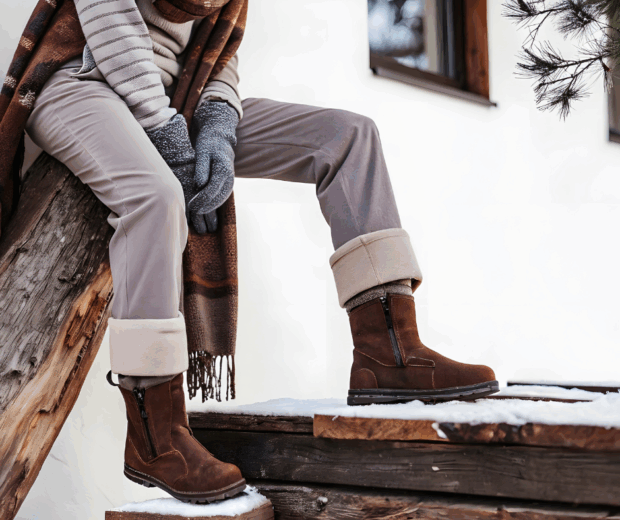
Winter boots are a necessity — but they’re also one of the top overlooked causes of bunion pain during the colder months. The wrong boot can accelerate bunion progression, cause flare-ups, increase swelling, and irritate the big toe joint daily.
If you feel like your bunions get worse every winter, your boots may be the reason.
Here are the six biggest warning signs that your winter boot is harming your bunion (plus how to fix it without sacrificing warmth or style).
✅ Sign #1: The Toe Box Narrows at the Front
Most winter boots taper inward at the toes — and for bunion sufferers, this is disastrous.
Why?
Because the bunion bump is located exactly where most shoes narrow.
When the toe box squeezes inward, it:
-
Pushes the big toe toward the second toe
-
Increases joint pressure
-
Irritates the bunion bump
-
Creates stiffness and inflammation
Quick Test:
Take the insole out and stand on it.
If your big toe or bunion hangs over the edge, the boot is TOO narrow.
✅ Sign #2: The Upper Material Is Stiff, Rigid, or Non-Flexible
Popular winter boots — especially fashion boots — often use:
-
Hard leather
-
Waterproof stiff synthetics
-
Reinforced toe caps
These materials don’t give the bunion room to breathe.
Why it matters
The bunion joint moves every time you walk.
When it is pressed against rigid material:
-
Movement becomes restricted
-
The bump experiences friction
-
Swelling increases
-
Pain accelerates with every step
Fix
Look for:
-
Soft leather
-
Stretchable uppers
-
Flexible toe caps
-
Wide-toe or “foot-shaped” designs
Your bunions should never have to fight your boots.
✅ Sign #3: Your Boot Tilts Your Foot Inward (Overpronation)
Many winter boots have:
-
Flat soles
-
Worn-down insoles
-
Zero arch support
-
Compressed midsole foam
This causes the foot to roll inward — increasing bunion pressure dramatically.
Overpronation = bunion progression.
Fix
Look for:
-
Boots with built-in arch support
-
Orthotic-friendly designs
-
Supportive insoles
-
Avoid totally flat boots
Replace insoles yearly — winter boots are often used harder than people realize.
✅ Sign #4: Your Socks Make the Boot Even Tighter
Winter means thicker socks.
Thicker socks mean your boot’s interior volume decreases.
Bunion sufferers often layer socks thinking it’s comforting — but instead:
-
It narrows the toe box
-
Increases friction
-
Crowds the toes
-
Forces the big toe inward
Fix
Wear:
-
Thin merino socks
-
Toe socks to improve toe splay
-
Avoid bulky wool socks in narrow boots
Or pair thin socks with a thin bunion sleeve for alignment + protection.
✅ Sign #5: You Experience End-of-Day Big Toe Throbbing
This is one of the biggest indicators your boots are harming you.
If your bunions:
-
Throb at night
-
Look red and irritated
-
Feel “pressure-like”
-
Swell only on days you wear certain boots
…your footwear is the culprit.
What’s happening:
Toe compression + stiff uppers + cold weather → joint inflammation cycle.
The longer the irritation, the worse the flare-ups.
✅ Sign #6: You Avoid Long Walks Because of Your Boots
If you stop doing normal winter activities because your boots hurt your bunions, it’s a major sign they are the wrong pair.
Pain should NOT be a daily part of winter.
Fix
Try:
-
Boots with anatomical toe shapes
-
Winter shoes that mimic barefoot footwear (with insulation)
-
Adding a corrector under the sock for alignment support
This alone can reduce activity-related bunion pain dramatically.
✅ How to Choose a Winter Boot That Supports — Not Worsens — Your Bunions
✅ Choose Wide Toe Boxes
Brands with foot-shaped designs are best.
✅ Look for Soft Uppers
Avoid rigid synthetics and hard leather.
✅ Test Toe Movement
You should be able to wiggle your toes easily — even with socks.
✅ Check Where the Boot Creases
If the crease hits your bunion bump? Don’t buy it.
✅ Consider a Thin Bunion Corrector Layer
Thin splints (like Bunion Bootie) do three things:
-
Reduce friction
-
Provide gentle alignment
-
Protect the bump from hard materials
They work inside boots where bulkier splints can’t.
✅ Final Thoughts
Winter boots can either be your best friend or your worst bunion enemy.
By choosing the right design — and avoiding the six red flags above — you can significantly reduce pain, inflammation, and bunion progression throughout the season.
Your feet carry you through everything the winter months demand.
Give them the space, structure, and support they deserve.